Obsah
A screw press juicer should be evaluated using the fruit or vegetable and final juice specification the processor intends to produce. Input capacity alone does not show how much acceptable juice reaches the next process stage. Buyers also need to understand preparation, extraction yield, pulp carryover, cleaning access and the handling of discharged solids.
This guide explains how to organize a screw press juicer trial and turn the results into a useful purchasing specification. It addresses extraction equipment and workflow. Extraction does not by itself establish product safety, shelf life or a complete juice-processing system, so the production plan needs its own process and food-safety assessment.
Define raw material and juice for a screw press juicer
Describe the intended fruit or vegetable, variety where relevant, maturity, initial condition and preparation method. State whether material will arrive washed, sorted, peeled, cut or otherwise prepared. A screw press juicer trial is only representative when its input resembles the material the processor will actually use.
Define the required juice characteristics and the next processing step. A cloudy juice, a juice intended for further clarification and an ingredient for another product may have different acceptance criteria. The screw press juicer should be evaluated against those criteria rather than judged only by the amount of liquid seen at the outlet.
Identify seeds, stones, tough fibers, peel and other features that may affect preparation or machine suitability. Ask the supplier what must be removed before feeding. A large feed opening should not be interpreted as approval to process every whole fruit without preparation. The exact input restrictions belong in the specification and operator instructions.
Understand the screw press juicer extraction mechanism
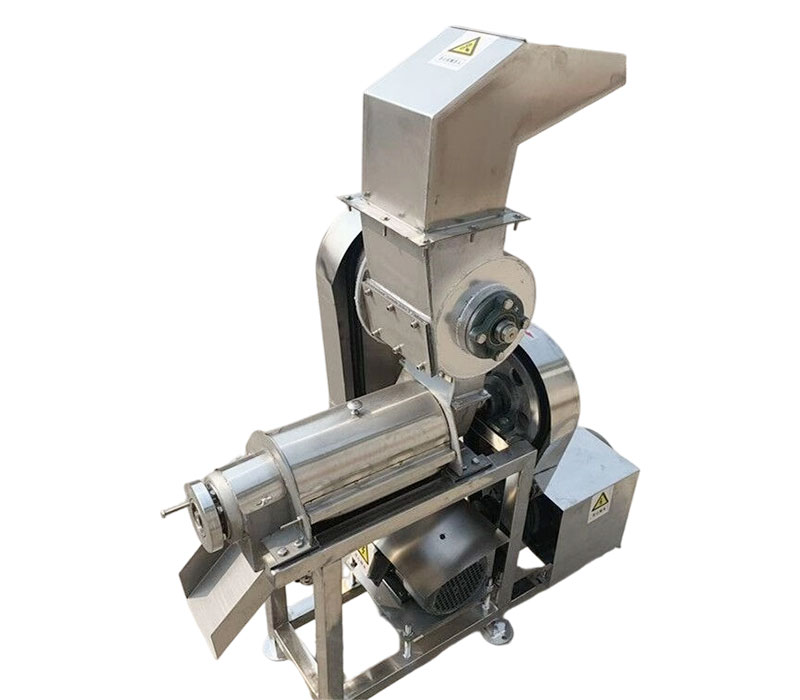
A screw press conveys material through a progressively restrictive pressing region, separating liquid from the discharged solids through the screen arrangement. Material behavior and the selected configuration affect the result. A screw press juicer should therefore be quoted with its relevant screw, screen and discharge arrangement identified.
Jinyuan describes a fruit and vegetable juicer using screw extrusion with automatic juice and residue separation. Its page lists a 1.5 kW motor, a 0.6-millimeter filter aperture and a nominal 500-kilogram-per-hour input figure for the described configuration. Confirm the exact model and material basis before using these figures to plan a screw press juicer installation.
Do not interpret the published input rate as juice output or a guarantee for every raw material. Likewise, a screen aperture does not establish that the juice meets every downstream clarity specification. Ask for a representative trial and identify whether any additional filtration or other process stage is needed for the intended product.
Prepare a controlled material trial
Choose a material batch large enough to observe stable behavior and ordinary interruptions. Record the batch identity, preparation, initial mass and condition. Keep the raw material consistent when comparing screw press juicer configurations, or document the differences clearly enough to interpret the results.
Agree on machine settings, feed method, collection containers and the trial period before starting. Weigh the input and all collected output fractions using suitable scales. Include startup material and material retained in the screw press juicer in the mass-balance discussion rather than letting those amounts disappear from the report.
If the supplier changes the screen, discharge restriction or preparation method during the trial, record each condition separately. Do not combine the best yield from one setup with the highest capacity from another and present both as one result. A useful report shows the tradeoffs that the buyer must actually choose between.
Measure yield and capacity as different results
Extraction yield can be expressed as collected juice mass divided by input material mass for a clearly defined trial boundary. Input capacity is material processed per unit time. Accepted juice output is juice meeting the agreed specification per unit time. A screw press juicer should be evaluated using all three where they affect the purchase.
For example, 100 kilograms of prepared material yielding 60 kilograms of collected juice represents a 60 percent mass yield before accounting for any downstream rejection or treatment. If the run took 30 minutes, the input rate was 200 kilograms per hour and the collected juice rate was 120 kilograms per hour. These are arithmetic illustrations, not Jinyuan trial results or a promised screw press juicer yield.
Report the remaining solids, losses and hold-up so that the material balance can be reviewed. Keep the measurement interval consistent. A short run can overstate or understate performance if the screw press juicer begins empty and finishes holding substantial material. State how startup and shutdown fractions were handled when comparing results.
Check pulp carryover and downstream needs
Inspect the collected juice using an agreed method for suspended solids, texture or other relevant product attributes. The method should suit the processor's actual product. A screw press juicer that produces acceptable extraction yield may still need downstream separation if the required juice specification is more demanding.
Evaluate screen behavior and the frequency of cleaning or intervention. Fibrous materials may behave differently from soft, watery materials. Ask which screen options are available and what effects the supplier expects on yield, capacity and pulp carryover. Confirm those effects with trials rather than assuming that a finer screen always improves the complete process.
Include the downstream line in the capacity discussion. Tanks, pumps, filtration, treatment and filling may impose a lower rate than the extraction machine. A screw press juicer selected for its maximum nominal input can add little practical capacity when the next stage cannot handle the resulting juice or when cleaning interrupts the line frequently.
Evaluate screw press juicer cleaning access
Request a demonstration of shutdown, isolation, disassembly, inspection and reassembly using the manufacturer's procedure. Identify surfaces that contact juice and raw material, including screens, seals, screw surfaces, outlet passages and residue-discharge areas. A screw press juicer should be assessed for actual cleaning access rather than the appearance of its exterior stainless steel panels.
Ask for the material and surface information relevant to the supplied configuration. A stainless steel description alone does not prove that a complete food process is hygienically validated. Confirm cleaning-agent compatibility, drainage and the procedure for inspecting areas where material can remain. Record the tools and time needed to clean the screw press juicer under representative operating conditions.
FDA's HACCP overview explains the use of hazard analysis and controls throughout food processing. Use that as background when developing the plant's own product and process assessment. It is not a certification of this machine. The responsible processor needs a food-safety plan appropriate to the product, destination and complete production process.
Compare proposals on a common basis
Ask each supplier to identify the raw material, preparation and product specification used to support its offer. A screw press juicer quotation based on a different fruit, screen or feed method should be treated as a different test condition until the intended application is demonstrated.
| Comparison item | Trial evidence | Purchasing implication |
|---|---|---|
| Raw material | Batch, condition and preparation | Establishes whether the trial is representative |
| Input capacity | Weighed input over measured time | Defines the extraction-stage duty |
| Juice yield | Juice mass relative to input mass | Helps estimate raw-material utilization |
| Accepted juice | Agreed product checks | Shows what can proceed to the next stage |
| Residue | Mass, handling and discharge behavior | Defines solids-management requirements |
| Cleaning | Demonstrated access and complete cleaning time | Reveals hygiene and changeover workload |
Include the offered motor, supply, screen, controls and accessories in the comparison. Ask the supplier to identify any separate equipment required for preparation or post-processing. A screw press juicer package should not be described as a complete juice line unless the line scope is explicitly defined and supported by the proposal.
Plan installation and residue handling
Lay out raw-material delivery, operator access, juice collection, residue removal and cleaning movement. Keep the flow suitable for the plant's hygiene plan. An electric drive needs compatible voltage, phase and frequency, with connection and protection assessed by a qualified electrician.
Confirm inlet and outlet heights, container clearance, machine weight and handling points. Include the route through doors and the space needed to withdraw service components. A screw press juicer can fit its floor footprint while still lacking enough room for cleaning or maintenance. Obtain dimensional information for the supplied arrangement rather than estimating from a catalog photograph.
Plan how residue will leave the screw press juicer and where it will go. A blocked or inconvenient residue route can limit production even when extraction runs smoothly. Evaluate the full shift with ordinary container changes and handling. Include wastewater and cleaning materials in the process layout so that they do not become an improvised addition after installation.
Send Jinyuan a material-specific inquiry
Provide the intended fruits or vegetables, preparation method, daily input, target juice specification and productive operating hours. Include electrical details, available space and the destination. Request a screw press juicer trial using representative material, with separate results for input capacity, yield, juice quality and cleaning time.
Ask for the exact configuration, screen reference, manual, spare-parts information and the scope of any additional equipment. Use the produktová stránka nebo poptávkový formulář to share the trial requirements. A material-specific offer gives the processor a clearer basis for budgeting, layout planning and acceptance than a nominal hourly input figure alone.
Přezkoumat screw press juicer product information a Stroje na zpracování ovoce rozsah a poté odešlete podrobnosti o aplikaci pro nabídku specifickou pro konfiguraci.
Často kladené otázky
Does screw press juicer input capacity equal juice output?
No. Input capacity is raw material processed per unit time. Juice output depends on yield, product acceptance and downstream handling. Measure input and collected fractions separately during a representative trial.
Can a screw press juicer process every fruit without preparation?
Do not assume so. Seeds, stones, peel, fibers and material dimensions may affect suitability. Ask the supplier to define preparation and input restrictions for the exact model and intended raw material.
Does a finer screen always produce a better result?
A finer screen may change pulp carryover, capacity, cleaning frequency and yield. Compare the complete result against the required juice specification using controlled trials rather than screen aperture alone.
Does a stainless steel screw press juicer establish juice safety?
No. Equipment materials are one part of a complete process assessment. The processor must address raw materials, cleaning, hazards, any required treatment, packaging and storage for the intended product and market.
What should Jinyuan receive before quoting a screw press juicer?
Send the raw material, preparation, daily input, target juice characteristics, electrical supply and space constraints. Request a representative trial with yield, accepted output, residue and cleaning records for the proposed configuration.