Table of Contents
An orchard air blast sprayer should be selected around the orchard canopy and the intended application method. Tank volume, fan diameter and advertised reach describe parts of the orchard air blast sprayer, but they do not demonstrate that the target canopy receives a consistent application. Calibration connects travel speed, nozzle output and the treated area with the operator's approved application plan.
For distributors and commercial growers, an equipment trial should answer whether an orchard air blast sprayer can be adjusted, measured and maintained for the intended blocks. This guide explains the information to gather before requesting a quotation and the checks that make a calibration demonstration useful. Product-label instructions and locally applicable requirements remain the basis for any pesticide application.
Describe the orchard blocks and target canopy
Prepare a simple block map showing row spacing, row length, headlands, slope, access width and water refill points. Record the crop and the approximate canopy height and width during the intended application season. An orchard air blast sprayer used in a young planting may need a different nozzle pattern and airflow arrangement from the same machine used in a mature block.
Identify sensitive areas, including neighboring crops, occupied buildings, roads and waterways, before choosing an operating route. Do not use advertised spray reach as a planning target. The useful question is how the orchard air blast sprayer places the approved spray on the intended canopy while the operator follows the product label, weather limits and applicable local procedures.
Send the block information with the inquiry rather than describing the orchard only by total hectares. Two sites of equal area may have different turning constraints, refill distances and canopy shapes. These differences affect the time available for spraying and the practicality of the proposed machine. They also determine which adjustments need to be demonstrated during supplier handover.
Separate tank capacity from application capacity
Tank volume affects the amount carried between refills. Field capacity also depends on travel speed, treated width, turning, refill time and the working pattern. An orchard air blast sprayer with a larger tank may complete fewer interruptions, but it must still fit the available access and transport arrangements.
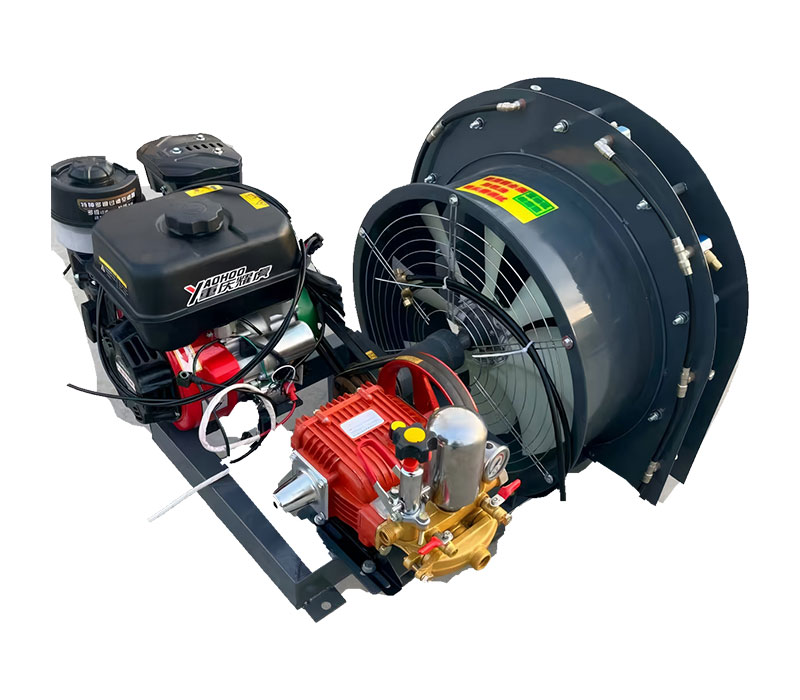
Jinyuan's wind-powered sprayer page describes an orchard air-blast configuration with a 300-liter tank, a fan and multiple nozzles. Confirm the exact drive arrangement, nozzle configuration, dimensions and loaded handling requirements in the quotation. Some descriptions cover several machine types, so ask which arrangement is included in the proposed orchard air blast sprayer.
Build a complete-cycle estimate. Include mixing and filling under the approved procedure, travel to the block, spraying, turns, return and cleanup. Do not divide tank capacity by an assumed application rate and call the result daily output. A useful estimate identifies each assumption and can be checked against a water-only demonstration before the orchard air blast sprayer is put into service.
Inspect the orchard air blast sprayer before measuring calibration
Calibration cannot correct blocked filters, damaged seals or worn nozzles. Inspect the tank, suction line, filters, pressure gauge, hoses, valves and nozzle bodies. An orchard air blast sprayer should be clean and in serviceable condition before a measured test begins, with the orchard air blast sprayer manual available to the people performing the test.
Penn State Extension's air-blast sprayer preparation guidance emphasizes cleaning, filter inspection, nozzle identification, pressure-gauge checks and measured travel speed. Use these principles to prepare a supplier trial. They support reliable measurement rather than a particular chemical application rate. The orchard air blast sprayer still needs settings appropriate to its exact configuration and the intended orchard.
Check tires, coupling or hitch components, guards and control access using the manufacturer's instructions. Confirm that the supplied nozzle identifiers match the order. A replacement nozzle that appears similar can have a different output. Photograph each installed nozzle position and record its code so that later service does not silently change the calibrated arrangement.
Measure travel speed under representative conditions
Mark a measured course on terrain representative of the operating block. Time the orchard air blast sprayer over that distance in its normal working configuration and repeat the measurement. Ground speed should be measured rather than inferred from a gear label. An orchard air blast sprayer may travel differently as the surface, tire condition and carried load change.
Convert the measured distance and elapsed time to the units used in the calibration calculation. For example, 100 meters traveled in 90 seconds corresponds to 4 kilometers per hour. This is a worked arithmetic example, not a recommended orchard operating speed. The approved speed must remain compatible with the orchard air blast sprayer manual, terrain, target coverage and application instructions.
Record the gear, engine or drive setting, tire condition, load and surface. If the orchard includes substantially different slopes or ground conditions, evaluate whether one travel setting remains representative. Consistent documentation allows another trained operator to repeat the method and gives a technician useful information when output changes during the season.
Measure nozzle output and check the application calculation
With clean water and an approved collection method, measure the output of individual nozzles over a known interval. Keep the test pressure and operating conditions stable, and follow the manufacturer's safe procedure. An orchard air blast sprayer should have its individual nozzle readings compared with the intended arrangement rather than checked only by watching the spray cloud.
Investigate an abnormal reading for blockage, wear, an incorrect nozzle or a measurement error. Use the nozzle manufacturer's replacement criteria. Do not compensate for one defective nozzle by adjusting the whole machine to a higher pressure. That can change the output and droplet characteristics of every other nozzle on the orchard air blast sprayer.
For a clearly defined effective treated width, the area-rate relationship is liters per hectare = 600 × total nozzle output in liters per minute ÷ travel speed in kilometers per hour ÷ effective width in meters. In orchard work, the treated-width convention depends on the pass pattern and whether one or both sides are sprayed. Have the application specialist confirm that convention before calculating settings. The equation does not determine a pesticide dose.
Adjust the spray pattern to the canopy
Use a water-only assessment and an appropriate coverage-checking method to see where the spray goes. Inspect upper, middle and lower canopy positions and the interior and exterior target areas. An orchard air blast sprayer should direct its active nozzle arrangement toward the target rather than sending an unnecessary portion above or below it.
Discuss which nozzle positions can be changed or shut off and how airflow can be adjusted on the proposed machine. Record the settings for each representative block. A visible cloud beyond the trees is not evidence of useful coverage. The orchard air blast sprayer should be evaluated for the actual target pattern and with attention to conditions that could carry spray outside the intended area.
Changes in canopy development can require a new assessment. Do not assume that a setting demonstrated in an open young orchard remains suitable after the canopy becomes dense. Build inspection and recalibration into the seasonal operating plan. Keep the application settings linked to the block and stage of growth so that operators can identify the appropriate approved setup.
Compare suppliers on calibration capability
The purchasing comparison should include the adjustment range, measurement access and service information supplied with the orchard air blast sprayer. An orchard air blast sprayer is easier to maintain consistently when the buyer can identify nozzles, repeat speed measurements and obtain the correct replacement components.
| Purchasing question | Evidence to request | Decision value |
|---|---|---|
| Does it fit the block? | Dimensions, turning demonstration and drive details | Checks access and handling |
| Can output be measured? | Safe test procedure and nozzle identification | Enables repeatable calibration |
| Can the pattern be adjusted? | Nozzle positions and available airflow settings | Supports different canopies |
| Is the gauge useful? | Gauge specification and check method | Supports consistent pressure settings |
| Can it be maintained locally? | Filters, seals, hoses and nozzle part references | Reduces avoidable service delays |
| Can operators repeat the setup? | Training and recorded block settings | Improves handover between operators |
Clarify which accessories and documents are included. For an orchard air blast sprayer that uses an external drive, confirm compatibility and guarding as part of the complete package. Request configuration-specific documentation if the supplier offers more than one power arrangement under a similar product name.
Build a calibration record that operators can use
Use a record with the orchard air blast sprayer identification, date, operator, block, water-only test conditions, measured speed, test pressure and nozzle output. Add nozzle position codes, active sides and the effective-width convention. An orchard air blast sprayer setting without those details can be difficult to reproduce reliably.
Keep application records separate from equipment test records while linking both to the orchard air blast sprayer identification. Equipment calibration establishes delivery behavior. The approved application plan determines the product and legally permitted use. This separation helps avoid treating a generic supplier demonstration as authorization for a particular orchard treatment.
Recheck after a nozzle replacement, repair, material change to the drive setup or an unexplained change in tank usage. Keep the previous record so that the difference can be investigated. A trend toward uneven output may point to a service problem that is more useful to correct early than to compensate for with repeated setting changes.
Prepare a practical inquiry and handover plan
Send Jinyuan the crop, canopy dimensions, row layout, available power arrangement, expected operating window and transport requirements. Request an orchard air blast sprayer configuration with a water-only calibration demonstration, identifiable nozzle components and a maintenance package. Ask the supplier to distinguish confirmed specifications from options requiring further selection.
At handover, have the intended operator repeat the speed measurement and explain how the nozzle settings are recorded. Confirm how the orchard air blast sprayer is cleaned and inspected under the supplied instructions. Use the inquiry form to share the orchard map and request a configuration-specific proposal. A clear, repeatable setup is a more useful purchase outcome than a machine demonstrated only by its visible spray distance.
Review the orchard air blast sprayer product information and the Agricultural Spray range, then send the application details for a configuration-specific quotation.
Frequently asked questions
Does a larger orchard air blast sprayer tank prove higher daily output?
No. Tank volume affects refill frequency, while daily capacity also depends on access, speed, turns, filling time and the application plan. Compare the complete working cycle for the intended orchard blocks.
Should an orchard air blast sprayer be calibrated with pesticide in the tank?
Prepare and measure the equipment using clean water and the manufacturer’s approved procedure. Determine any chemical application through the product label, qualified application advice and locally applicable requirements after equipment delivery has been checked.
Why measure individual nozzle output?
A total tank-usage figure can conceal differences between nozzles. Individual measurements help identify blockage, wear or an incorrect component and make the intended distribution easier to check and reproduce.
Can one orchard air blast sprayer setting cover every block?
It depends on the canopy, spacing, pass pattern and terrain. Keep measured records for representative blocks and reassess when the canopy or equipment changes instead of assuming one setup remains suitable everywhere.
What should Jinyuan receive before proposing an orchard air blast sprayer?
Provide the crop, canopy size, row dimensions, terrain, available drive, operating window and transport needs. Ask for the exact configuration, adjustment details, nozzle references, training scope and water-only trial method.