বিষয়বস্তুর সারণী
An air blast sprayer purchase should begin with the orchard that the air blast sprayer must serve. Tree height, canopy shape, row access and the refill route can matter as much as tank capacity. A quotation built around a generic spray-distance claim leaves the buyer without enough information to judge whether the proposed configuration will deliver a controlled application in that orchard.
This guide explains how to prepare an air blast sprayer purchasing brief for Jinyuan. It separates the orchard description, equipment package and acceptance evidence so suppliers can answer concrete questions. Chemical selection, dose and application restrictions follow the pesticide label and applicable local requirements; an equipment specification supports those decisions without replacing them.
Describe the orchard for the air blast sprayer proposal
Give the crop, training system, typical tree height and canopy width. Include the variation between young and mature blocks if one machine will serve both. A uniform narrow canopy presents a different delivery problem from irregular mature trees, even when both orchards occupy the same area.
Record row spacing, the available travel corridor and headland dimensions. Identify low branches, irrigation fittings and other clearance restrictions. An air blast sprayer must be evaluated as a complete operating package, including its drive or towing arrangement and the operator's route through the block.
Provide photographs or a simple orchard drawing with measured dimensions. Mark the filling point and the longest route from it to a working block. The supplier can then distinguish time spent applying spray from time spent traveling, filling and maneuvering.
Define the complete air blast sprayer package
State whether the inquiry is for a complete machine or a fan-and-pump assembly to integrate into another system. List the required tank, frame, wheels, controls, drive and liquid circuit. A component assembly and a complete orchard package should have separate scope descriptions and prices.
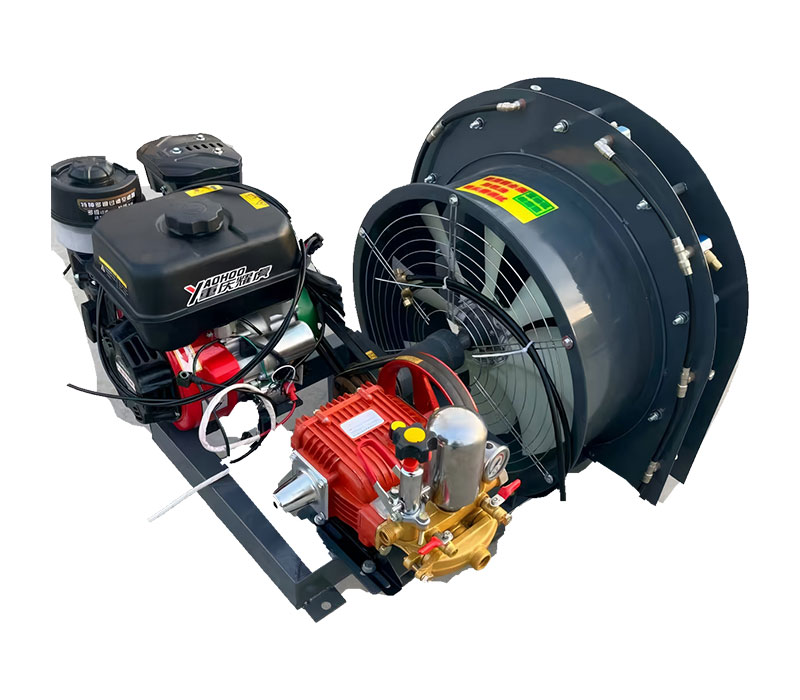
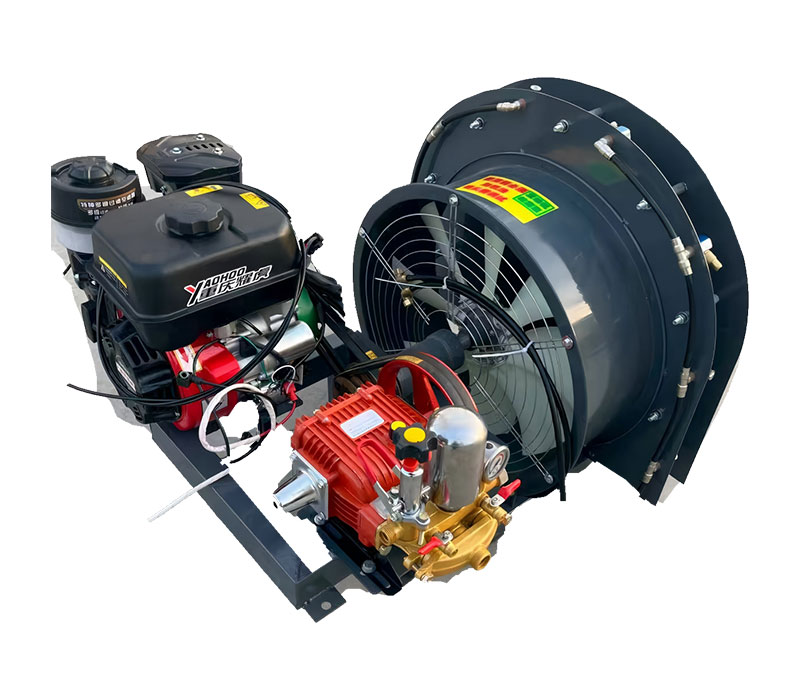
Jinyuan's wind-powered sprayer page describes an orchard application and lists tank, pump, fan and nozzle information. Request a quotation identifying the exact offered configuration and current dimensions. The media-library photographs show a fan-and-pump assembly; they should not be treated as photographic evidence of every tank or frame option in the listing.
For a tractor-driven or towed air blast sprayer, give the available tractor information and request the approved compatibility requirements. For an independently powered package, identify the engine, starting arrangement and controls. Confirm connection details and guarding from the proposed configuration rather than assuming that similar-looking equipment will connect correctly.
Specify air blast sprayer air and liquid controls
Ask how the proposed machine adjusts air delivery and directs it toward the intended canopy. Request information about the available settings, deflectors or other relevant arrangements. The objective is an application that can be configured for the orchard, not the largest possible air movement regardless of the target.
The liquid circuit should be described with identifiable components. Request the air blast sprayer, regulator, gauge, filtration and nozzle references. Ask which controls allow the operator to manage delivery at row ends and when one side is not required. Confirm whether these items are included in the air blast sprayer quotation.
Nozzle selection should be linked to the intended application and the chemical label. Request nozzle information that allows the delivery arrangement to be checked and reproduced. An advertised maximum pump pressure does not define the correct nozzle pressure or prove uniform distribution across the canopy.
Make air blast sprayer tank planning practical
Tank capacity affects refill frequency and the operating package's mass. Ask for nominal and usable capacity definitions, empty mass and the configuration used to state overall dimensions. The suitability of the complete filled arrangement must be checked against the manufacturer's instructions and the buyer's operating conditions.
For a hypothetical planning example, a 300-liter usable quantity divided by an assumed carrier volume of 600 liters per hectare represents 0.5 hectare of treated area. This is arithmetic using stated assumptions, not a recommended spray rate or a verified capacity for a Jinyuan air blast sprayer. Actual application volume is established through the permitted application plan and calibration.
If a block is larger than the area covered by one fill, map where the operator returns to refill and how the route resumes. Include filling, mixing under the site's procedures and travel time in the daily plan. A nominal tank-size comparison alone does not show which package finishes the orchard within the working window.
Request air blast sprayer calibration provisions
The buyer should be able to measure liquid output and check distribution using an agreed procedure. Ask what access and information the machine provides for those checks. Obtain nozzle references and the manufacturer's operating instructions so the evaluated configuration can be reproduced after service or replacement.
Use clean water for preliminary equipment checks and setup evaluation. Document the relevant speed, nozzle configuration and control settings. A change in any important variable may change delivery. The calibration record should identify the actual air blast sprayer and its configuration rather than only the orchard name.
The University of Georgia's orchard sprayer guidance provides general background on sprayer components and setup considerations. It can help structure a technical discussion, while the final operating procedure must reflect the actual machine, pesticide label and local requirements. General extension guidance is not a model-specific performance guarantee.
Agree an air blast sprayer demonstration
Define what the demonstration must establish. Useful observations include physical access, controls, filling arrangements, measured liquid delivery and a suitable check of distribution at the intended target locations. Agree the observation method with appropriate application expertise rather than judging success only by a visible cloud beyond the trees.
| Demonstration topic | Buyer supplies | Supplier should clarify |
|---|---|---|
| Orchard access | Row and headland measurements | Complete package dimensions and maneuvering needs |
| Canopy target | Height, width and representative locations | Available air and nozzle adjustment arrangements |
| Liquid delivery | Agreed calibration procedure | Nozzle references and measurable operating settings |
| Refill cycle | Filling point and working route | Usable capacity and filling arrangements |
| Service access | Local maintenance capability | Parts identification and access instructions |
A factory demonstration may use a different layout from the buyer's orchard. Record that limitation and decide which observations require a site check. An air blast sprayer running with clean water in an open yard can establish certain functions, but it does not reproduce delivery through a particular canopy.
Ask for a report identifying the demonstrated machine and all relevant settings. If the demonstration includes an alternative nozzle or drive arrangement, make that difference visible. The accepted quotation should match the configuration that supports the buying decision.
Include air blast sprayer service and receipt requirements
Request parts identification for nozzles, filters, seals, hoses and other components relevant to the offered package. Ask which items are common across configurations and which are model-specific. A distributor can then plan a useful stock instead of ordering an unidentified collection of spare parts.
Clarify cleaning, draining and storage instructions for the actual liquid circuit. Chemical handling and waste management remain governed by the label and the site's procedures. Ask how the air blast sprayer is accessed for inspection and service without removing guards or bypassing the manufacturer's intended protection during operation.
At receipt, check the model, supplied components and documents against the accepted scope. Record visible condition and any substitutions before commissioning. Retain the nozzle and pump identification with the machine record so later calibration and service work can refer to the same configuration.
Send a focused air blast sprayer inquiry to Jinyuan
Supply the orchard drawing, crop and canopy description, available drive arrangement and working window. Add the refill route, preferred package type and any access limitations. State the evidence expected from a demonstration and which installation details require further discussion.
Request an air blast sprayer response that identifies the complete scope, control arrangements, nozzle references, compatibility requirements and service support. Ask the supplier to mark unresolved requirements explicitly. This makes it easier to compare proposals and prevents a general catalogue statement from becoming an unintended acceptance promise.
Review Jinyuan's wind-powered sprayer product information and agricultural spray range, then submit the orchard brief through the inquiry form below. A useful purchase connects a documented orchard with an identifiable machine and a repeatable evaluation method. Those details give the buyer a practical basis for choosing equipment and organizing commissioning.
Review the air blast sprayer product information and কৃষি স্প্রে range, then send the application and evidence requirements for a configuration-specific proposal.
Frequently asked questions
What should an air blast sprayer quotation request contain?
Include crop and canopy dimensions, row and headland access, the available drive arrangement and refill route. Specify whether a complete machine or an assembly is required. Request identified components, controls, compatibility information and demonstration evidence for the offered configuration.
Does the largest air blast sprayer tank always finish an orchard faster?
A larger usable fill can reduce refill trips, but package mass, access and maneuvering also affect the working cycle. Compare application, filling and travel time for the actual orchard. Use a calibrated carrier requirement and manufacturer-approved operating arrangement in the plan.
Can spray distance prove air blast sprayer canopy coverage?
No. A visible plume or advertised distance does not establish distribution at the required target locations. Agree an appropriate coverage observation method and evaluate the intended canopy and configuration. Chemical-use decisions continue to follow the pesticide label and applicable requirements.
What should an air blast sprayer factory demonstration identify?
Record the machine, drive, nozzles, relevant settings and measurement procedure. Separate observations supported by the factory layout from those requiring an orchard check. Make any differences between demonstrated and quoted equipment explicit before accepting the proposal.
Which air blast sprayer service details should I confirm before ordering?
Ask for parts references, cleaning and storage instructions, service access and the available support arrangement. Confirm nozzle, filter, seal and hose identification for the actual package. Retain that information with the accepted scope and calibration records.